



How to Use AI for Personal Finance in 2026
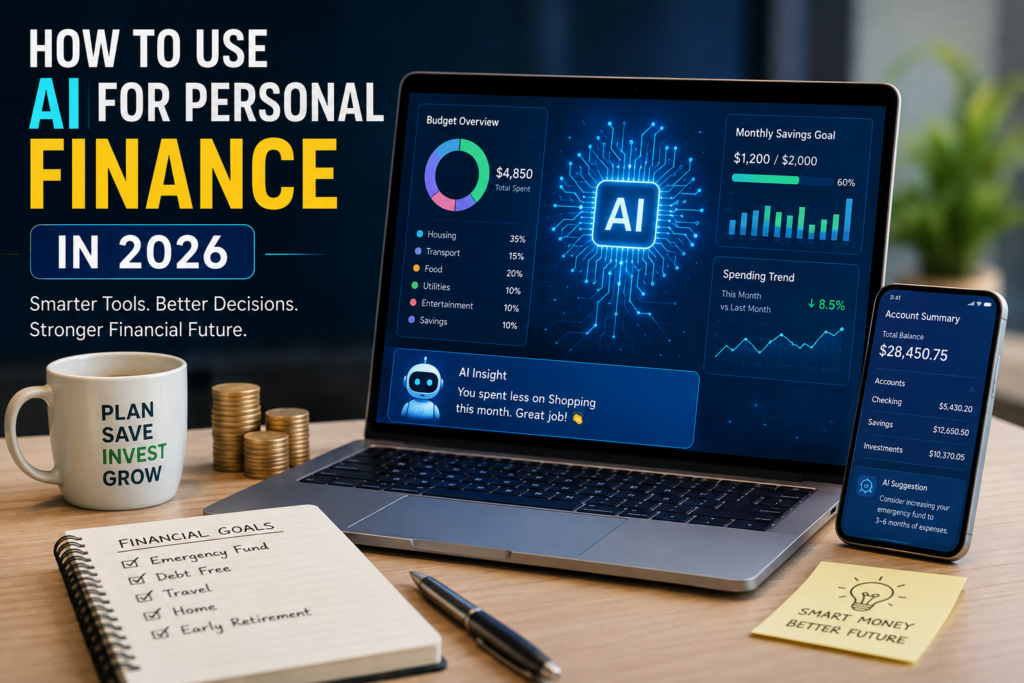
AI is changing the way people learn about, organize, and manage their money. In 2026, artificial intelligence can help with everyday financial tasks such as creating a budget, categorizing expenses, understanding financial terminology, comparing options, setting savings goals, and preparing questions for a qualified financial professional.
Research published in 2026 found that people are already using large language models for several personal-finance tasks, with investment research, savings planning, budgeting, and tax planning among the most common uses.
However, AI should be treated as a financial assistant and educational tool—not an unquestionable financial adviser. AI can make mistakes, misunderstand your circumstances, use outdated information, or produce confident-sounding answers that are not appropriate for your situation. The OECD has specifically highlighted risks involving inaccurate information, bias, commercial influence, privacy, and exclusion.
This guide explains practical ways to use AI for personal finance while keeping human judgment at the center.
What Is AI Personal Finance?
AI personal finance refers to using artificial intelligence to help with financial organization, education, planning, and analysis.
Instead of manually sorting every expense or spending hours trying to understand a financial concept, you can use an AI tool to organize information and explain it in simpler language.
Depending on the tool, AI may help you:
- Build a basic budget
- Categorize spending
- Identify recurring expenses
- Create savings plans
- Explain financial terminology
- Organize financial goals
- Compare financial concepts
- Model hypothetical scenarios
- Create debt-payment worksheets
- Prepare questions for a financial professional
- Analyze information you provide
The technology is becoming increasingly accessible. In 2026, AI-powered financial tools range from conversational assistants to dedicated budgeting applications and other financial software.
Why Use AI for Personal Finance in 2026?
Managing money can become complicated because financial decisions involve many small details.
You may need to keep track of income, spending, subscriptions, savings, bills, financial goals, and unexpected expenses. AI can help organize these details and turn complicated information into easier-to-understand summaries.
A 2026 study published in the Journal of Behavioral and Experimental Finance found that 67.8% of surveyed participants had used an LLM for at least one personal-finance task.
The important point is that AI doesn’t necessarily need to make the financial decision for you. Its biggest advantage can be helping you understand the decision before you make it.
1. Use AI to Build a Simple Budget
One of the easiest ways to use AI for personal finance is creating a budget.
You can provide general information such as:
- Monthly income
- Regular bills
- Transportation costs
- Food expenses
- Savings goals
- Entertainment spending
- Other recurring expenses
AI can then organize these categories and help you identify areas that deserve closer attention.
For example, instead of asking:
“How can I become rich?”
A more useful prompt would be:
“Help me organize these monthly expenses into essential spending, flexible spending, and savings goals.”
This produces a much more practical result.
Important Tip
Avoid entering sensitive information such as passwords, PINs, complete bank-account numbers, card numbers, or identity documents into a general AI chatbot.
AI can help organize information without needing access to your most sensitive credentials.
2. Use AI to Understand Where Your Money Goes
Knowing where money goes is often the first step toward better money management.
AI can help categorize transactions into groups such as:
- Food
- Transportation
- Education
- Entertainment
- Bills
- Shopping
- Savings
- Other expenses
Once expenses are organized, you can ask AI to summarize patterns.
For example:
“Group these expenses by category and show me which categories represent the largest share of my spending.”
The goal isn’t to let AI criticize your spending. Instead, use it to make your financial information easier to understand.
3. Use AI to Set Savings Goals
Saving money becomes easier when a vague goal becomes a measurable plan.
For example, rather than saying:
“I want to save more.”
You can turn the goal into:
“I want to save a specific amount over a specific period. Help me create a realistic savings schedule.”
AI can help calculate different hypothetical scenarios and show how changing the amount or timeline affects the result.
For younger users, this can also be useful for learning basic concepts such as:
- Short-term saving
- Emergency savings
- Opportunity cost
- Compound growth
- Goal-based planning
The calculations should still be checked, especially when real financial decisions are involved.
4. Ask AI to Explain Financial Terms
Personal finance contains a huge amount of terminology.
Words such as APR, APY, inflation, compound interest, diversification, liquidity, credit utilization, and asset allocation can be confusing when you first encounter them.
AI can act as an on-demand tutor.
Try asking:
“Explain compound interest in simple language and give me a fictional example.”
Or:
“Explain the difference between APR and APY for a beginner.”
This educational use of AI is particularly valuable because you can ask follow-up questions until the concept makes sense.
Research on generative AI and personal finance found that users frequently treat LLMs as an on-demand tutor and search tool for financial concepts and information.
5. Use AI to Learn About Debt
AI can also help explain different debt concepts.
For educational purposes, you can ask it to explain:
- How interest works
- Minimum payments
- Principal versus interest
- Debt repayment strategies
- How repayment timelines work
- Why high-interest debt can become expensive
You can also ask AI to create a hypothetical repayment example using fictional numbers.
For real financial decisions, however, information should be verified against your lender’s terms and, when appropriate, discussed with a qualified professional.
6. Use AI to Find Unnecessary Spending
Another useful application is identifying recurring expenses.
You can ask AI to help organize a list of fictional or appropriately anonymized expenses into:
Essential → Useful → Optional → Review
This can make it easier to notice subscriptions or recurring purchases that deserve a second look.
AI isn’t deciding what you should buy. It is simply helping you organize the information so that you can make a more informed decision.
7. Use AI as a Financial Research Assistant
AI can save time when you’re learning about a financial topic.
For example, you can ask:
“What factors should I compare when evaluating two savings products?”
The answer can provide a checklist such as:
- Interest rate
- Fees
- Minimum balance
- Access requirements
- Withdrawal conditions
- Account protections
- Terms and restrictions
You should then verify important details directly with the relevant financial institution or official source.
This distinction matters because financial products and regulations can change.
8. Use AI to Create Financial Checklists
AI is excellent at turning complicated processes into checklists.
For example, you could ask:
“Create a beginner checklist for reviewing my monthly finances.”
The checklist might include:
- Review income.
- Review essential expenses.
- Check recurring subscriptions.
- Review savings progress.
- Review upcoming bills.
- Check whether spending matches your goals.
- Record questions that need professional advice.
This approach can make financial management less overwhelming.
9. Use AI to Compare Financial Concepts
AI can also explain differences between financial concepts.
For example:
- Saving vs. investing
- Fixed vs. variable expenses
- Simple vs. compound interest
- Traditional vs. high-yield savings
- Short-term vs. long-term goals
- Active vs. passive investing
When asking AI for comparisons, request a table containing advantages, disadvantages, risks, costs, and situations where each option may be appropriate.
Then verify important facts using reliable sources.
10. Use AI for Investment Education—Not Blind Decisions
Investment content is one area where extra caution is necessary.
AI can explain concepts such as:
- Diversification
- Risk and return
- Index funds
- Bonds
- Stocks
- Compound growth
- Asset allocation
- Investment fees
But you should not assume that an AI-generated investment recommendation is automatically correct.
Recent research has found that AI-generated financial recommendations can influence users’ portfolio choices, demonstrating why people need to evaluate AI advice carefully rather than following it automatically.
A safer approach is to ask:
“Explain the risks and factors I should understand before considering this type of investment.”
That is generally more useful than simply asking:
“What should I buy?”
11. Use AI to Prepare for a Conversation With a Financial Professional
AI doesn’t have to compete with human expertise.
It can actually help you prepare better questions.
For example, you could ask:
“Create a list of questions I should ask a qualified financial professional about my financial goals.”
This can help you understand what information you need before making important decisions.
Human professionals can consider context, goals, legal requirements, emotions, and other circumstances that an AI system may fail to understand.
Recent testing of AI chatbots on financial-planning scenarios found that their answers could be useful but also contained limitations, including mistakes, insufficient follow-up questions, and difficulty accounting for personal circumstances.
12. Protect Your Financial Privacy
One of the most important rules for using AI and personal finance is data privacy.
Never assume that a chatbot needs your complete financial identity to help you.
Avoid unnecessarily sharing:
- Passwords
- PINs
- Full debit or credit card numbers
- Banking login credentials
- Government identification numbers
- Security questions
- Private authentication codes
- Other highly sensitive credentials
Instead, anonymize information whenever possible.
For example, replace a real account number with:
[ACCOUNT NUMBER REMOVED]
You can also use rounded or fictional figures when you only need an explanation or example.
Privacy is a significant concern in AI-powered personal finance. The OECD’s 2026 policy paper specifically identifies data privacy and other consumer-protection issues as important risks.
13. Always Verify Important Financial Information
This may be the most important AI finance rule:
Don’t confuse a confident answer with a verified answer.
AI systems can generate incorrect information.
Before acting on important financial information, verify it using authoritative sources such as:
- Your bank or financial institution
- Government websites
- Tax authorities
- Official financial regulators
- Product documentation
- Qualified financial professionals
This is especially important for:
- Tax rules
- Interest rates
- Financial regulations
- Investment products
- Legal requirements
- Account terms
- Eligibility requirements
AI can help you find questions to ask, but it should not become your only source of truth.
14. Don’t Let AI Make Emotional Decisions for You
Money isn’t only mathematics.
Financial decisions can involve fear, excitement, stress, impatience, and social pressure.
An AI system may calculate a scenario without fully understanding the emotional or personal circumstances behind it.
For example, a mathematically attractive strategy may not necessarily be appropriate for someone’s real-world situation.
That’s why AI works best as a decision-support tool rather than an automatic decision-maker.
15. Build an AI-Assisted Monthly Money Routine
A simple monthly routine can make AI genuinely useful.
Step 1: Organize
Gather your income and expense information without exposing sensitive credentials.
Step 2: Categorize
Use AI to organize expenses into meaningful categories.
Step 3: Review
Ask AI to identify unusual patterns or areas that deserve attention.
Step 4: Plan
Create hypothetical savings or spending scenarios.
Step 5: Learn
Ask AI to explain anything you don’t understand.
Step 6: Verify
Check important information against authoritative sources.
Step 7: Decide
Make the final decision yourself or with appropriate human guidance.
This creates a useful balance between AI efficiency and human judgment.
Best AI Prompts for Personal Finance
Here are some practical prompts you can adapt using non-sensitive information:
Budgeting Prompt
“Help me organize these expenses into essential, flexible, and savings categories. Explain the reasoning behind each category.”
Savings Prompt
“Create three hypothetical savings scenarios for reaching a financial goal over different time periods.”
Financial Education Prompt
“Explain [financial term] in simple language, then give me a fictional example.”
Expense Analysis Prompt
“Analyze this anonymized list of expenses and identify recurring categories that I should review.”
Research Prompt
“Give me a checklist of factors I should compare before choosing between two financial products.”
Professional Advice Prompt
“Create questions I should ask a qualified financial professional about this financial topic.”
Common Mistakes to Avoid When Using AI for Finance
Mistake 1: Sharing Too Much Personal Data
AI doesn’t need your passwords or complete financial credentials to explain budgeting concepts.
Mistake 2: Treating AI as a Guaranteed Expert
AI can be useful, but it can also make mistakes.
Mistake 3: Following Investment Recommendations Without Research
An AI-generated suggestion should never replace independent research and appropriate professional advice.
Mistake 4: Ignoring Dates
Financial rules, rates, products, and regulations can change. Always check whether information is current.
Mistake 5: Asking Vague Questions
Specific questions generally produce more useful answers.
Instead of:
“How do I manage money?”
Try:
“Explain five beginner principles for organizing monthly expenses and setting savings goals.”
Is AI Good for Personal Finance in 2026?
Yes—when used correctly.
AI can make personal-finance education and organization faster and more accessible. Current research and industry guidance show that consumers are already using AI for budgeting, savings planning, investing-related research, and other financial tasks.
But AI also introduces risks.
The OECD warns about issues including hallucinations, bias, privacy, commercial influence, and uncertain effects on long-term financial well-being.
The best approach is therefore not “AI makes my financial decisions.”
It is:
“AI helps me understand my options, organize information, and ask better questions.”
Final Thoughts
AI for personal finance in 2026 is less about replacing financial knowledge and more about making that knowledge easier to access.
You can use AI to build a basic budget, organize expenses, learn financial terminology, explore hypothetical scenarios, create savings plans, and prepare questions for qualified professionals.
The smartest approach is to combine AI + reliable sources + human judgment.
Use AI for organization and education. Verify important information. Protect your private data. And never make a major financial decision simply because an AI system sounds confident.
When used responsibly, AI can become a practical tool for building stronger financial habits and improving your understanding of money in 2026.
Disclaimer: This article is for general educational purposes and does not constitute personalized financial, investment, tax, or legal advice. Financial rules and products vary by country and can change over time. Always verify important information with appropriate official sources or qualified professionals.